MY WORK

My work

The outputs of this research project, in one place.

THE WORKING PAPER

Protecting the Thinking Process in Human-AI Interaction: The Forum Interstitiale Between Thought and Expression

Working paper, July 2026. Comments welcome.

In January 2026 a United States court ordered the production of twenty million ChatGPT conversations. Three weeks later two federal courts looked at the same act, a litigant typing questions into a chatbot, and reached opposite conclusions in the same week. In June the Supreme Court held that records of where a person's body had been remain constitutionally protected.

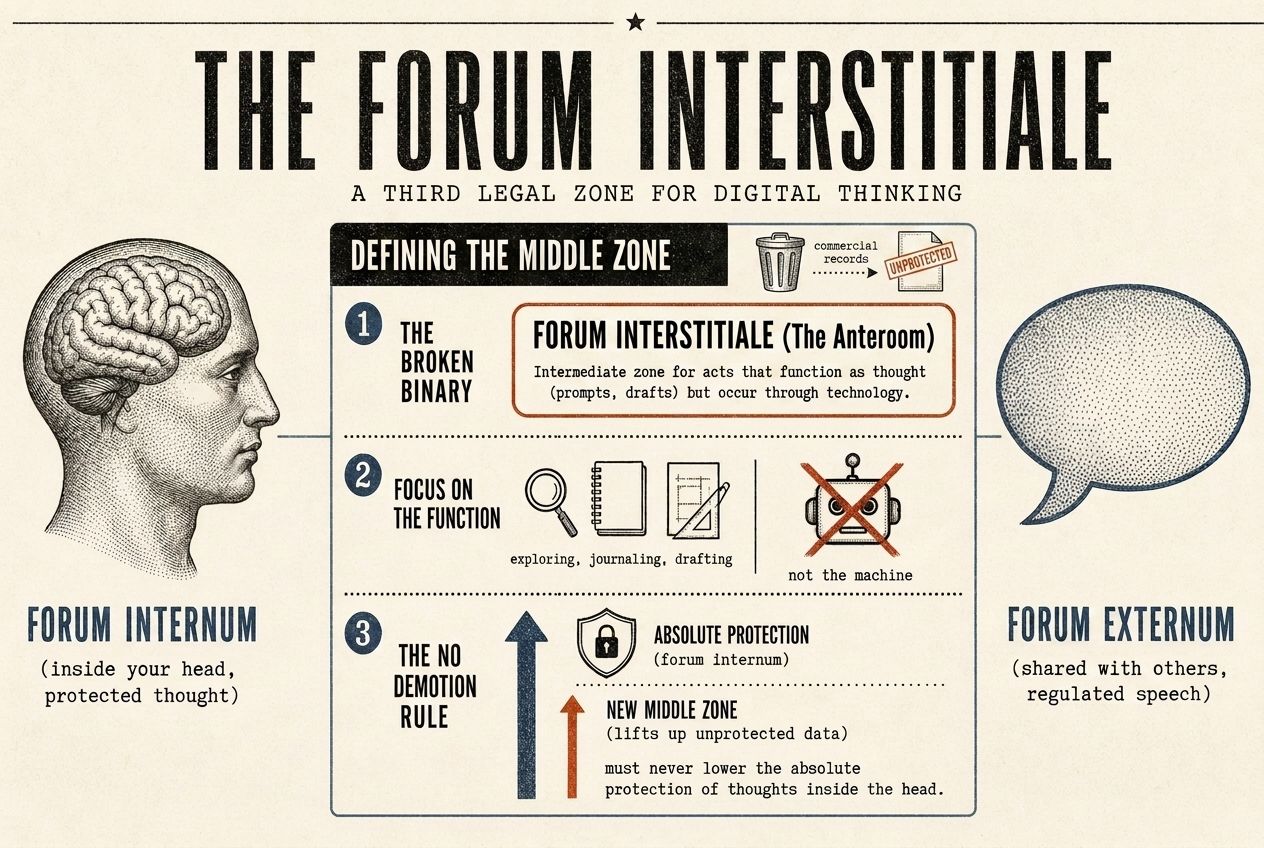
International law has two categories for thought. The forum internum is absolute. The forum externum can be limited. Neither holds the search query, the exploratory prompt, the unfinished draft, or the confession typed to a machine. This paper proposes a third, the forum interstitiale, and sets out what building it would require.

It tests every analogy existing law offers, from search queries and evidentiary privilege to protected reading, aggregated records, European correspondence and data protection law, private diaries, and neural data. Each protects part of the thinking process. Each fails at the same joint, because protection attaches to a relationship, a disclosure, a recording, an addressee, or a data type, and never to the function of the act as thinking.

Diagram placing the forum interstitiale, the anteroom, between the forum internum inside your head and the forum externum shared with others
The anteroom, mapped
Open the paper

DOI: 10.5281/zenodo.21633712

Also available on SSRN

SUGGESTED CITATION

Caroline De Cock, Protecting the Thinking Process in Human-AI Interaction: The Forum Interstitiale Between Thought and Expression (working paper, July 2026), https://doi.org/10.5281/zenodo.21633712

Licence: Creative Commons Attribution 4.0

Comments welcome at info@informationlabs.org

THE ARTICLE THE PROJECT BEGAN FROM

From Upload to Output Filters? How the AI Act's Code of Practice Could Threaten Freedom of Expression and Thought

Tech Policy Press, January 2025.

The argument this project grew from. It shows how rules written to police what AI systems produce can end up filtering private thought before a word is ever published. A softened version of the obligation it targeted survived into the adopted Code of Practice.

Read the article
THE BOOK

AI Tools, Not Gods

BTF Press, 2026.

The wider argument about what AI systems are and how their governance should be judged. The research on this site applies that lens to a single right.

About the book